-1.jpg)
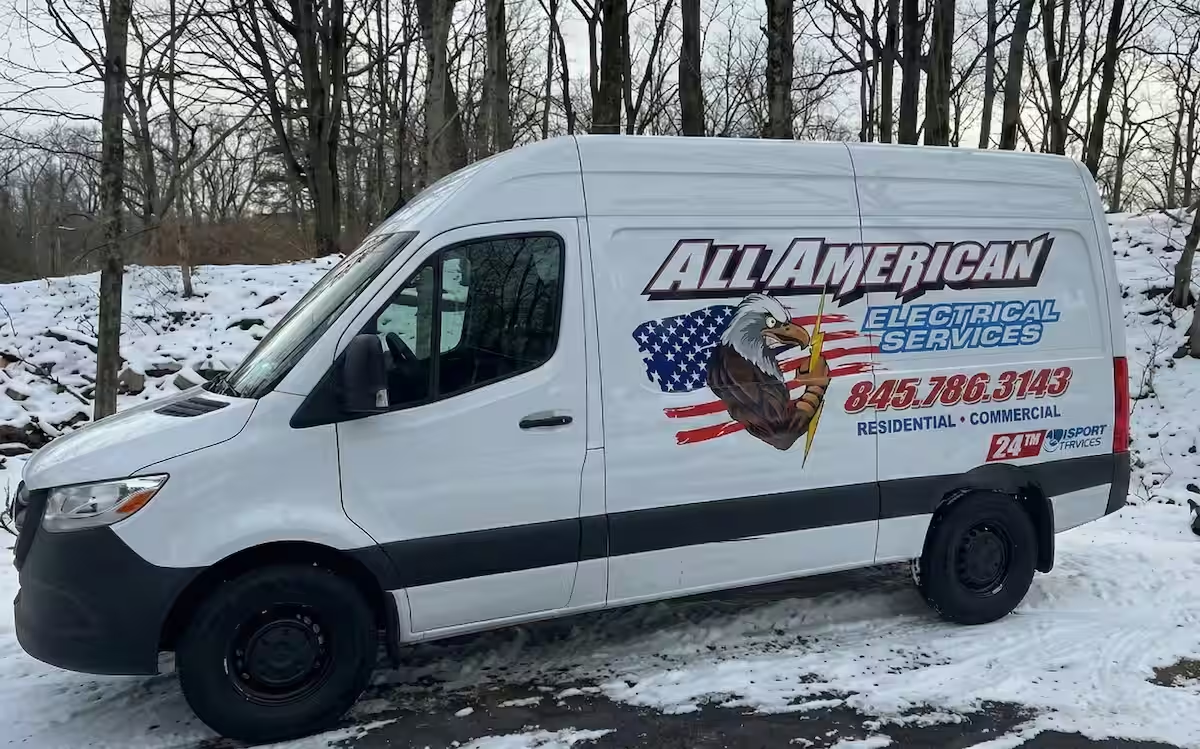
Orange County loses power differently to the rest of the Hudson Valley. The county runs from dense village streets in Middletown and Newburgh out to properties on Schunemunk and along the Wallkill where the nearest neighbour is a field away and the line runs through half a mile of trees. That spread is why two houses ten minutes apart can have completely different generator answers — and completely different bills.
This guide covers what a whole-house standby generator actually costs to install in Orange County in 2026, what drives the number up or down, how the permit process works here, and the fuel question that catches more Orange County homeowners out than anywhere else we work.
A fully installed residential standby generator in the Hudson Valley generally lands between roughly $6,500 and $15,000, and Orange County sits across that whole range rather than clustering in the middle. Our 2026 whole-house generator cost guide breaks the regional numbers down in detail.
That figure is the all-in cost, and it is worth being clear about what sits inside it, because advertised generator prices almost never include most of this:
If a quote looks unusually low, it is nearly always because one of the middle four is missing and will appear later as a change order.
In Rockland County, natural gas is the default assumption. In Orange County it very much is not. Large parts of the county — the more rural stretches around Warwick, Chester, Montgomery, Wallkill and out toward the western towns — have no gas main on the road at all. Depending on where you are, your utility may be Orange & Rockland or Central Hudson, and gas availability varies street by street even within a single town.
If you have natural gas, the connection is straightforward and the generator has an effectively unlimited fuel supply. If you do not, you are on propane, and that changes the project: you need a tank, a regulator, a buried or above-ground line, and a supply contract. It also changes how the generator behaves in a long outage, because a propane tank is finite.
Tank sizing is where Orange County homeowners most often get caught. A 100-gallon tank sounds substantial and is not — under real household load a mid-size generator will work through it far faster than most people expect, which is exactly the wrong discovery to make on day two of a February outage. If you are going propane and outages here run long, size the tank for the outage you are actually planning for, not the one you hope for.
On a village lot in Goshen or Cornwall, the generator often sits a short run from both the meter and the panel. On a five-acre property outside Warwick, the practical location may be forty or sixty feet from the house because of clearances, noise, or where the tank can go. Every extra foot is conduit, wire and trenching, and it adds up quickly.
Generator size comes from a load calculation, not square footage. What pushes Orange County homes into larger units is specific and predictable: well pumps and septic pumps. A large share of properties here are not on municipal water, and a well pump is a motor with a heavy starting surge. Add electric heat or a heat pump, a large air-conditioning system, or a workshop, and a house that looked like a 14 kW job becomes a 20 kW or 22 kW job.
This is not a place to economise. An undersized generator does not fail gracefully; it trips off under load, usually at the moment everything tries to start at once.
A generator installation touches the panel. If your service is old, full, or already marginal, that surfaces during the assessment rather than after. Signs are covered in our guide to the warning signs of an unsafe electrical panel, and the cost of putting it right is in our panel upgrade cost guide. Better to know before the generator is ordered.
Standby generator installation is permitted work throughout Orange County. Permits are issued at the town, village or city level rather than county-wide, so requirements and fees differ between Middletown, Newburgh, Monroe, Goshen, Warwick and the surrounding towns. Most jobs need an electrical permit, and where a gas line is run, a plumbing or mechanical permit as well.
Two local details matter more here than in the denser parts of the region. Setbacks — rural and semi-rural lots often have specific requirements about how close equipment can sit to a property line. And clearances — manufacturers specify minimum distances from windows, doors, vents and combustible walls, and those are enforced at inspection. A generator placed for convenience rather than to spec will fail, and moving a unit that is already on a pad and piped is expensive.
We pull the permits, schedule the inspections and coordinate the gas work as part of the job. Our article on how electrical permits work in this region gives a sense of the process, and the same principles apply across the county line.
For a house on municipal water and gas heat in a village centre with short, infrequent outages, a portable generator and a transfer switch may genuinely be the better value. We say so when it is true. Our comparison of standby versus portable generators in the Hudson Valley lays out that decision properly.
For a large share of Orange County homes, though, the arithmetic points the other way, for reasons specific to the area:
All American Electrical Services is licensed in Orange County as well as Rockland, Westchester, Sullivan, Ulster and Putnam. Phil Garabo has been installing and servicing generators across the Hudson Valley for more than twenty years, and every installation is sized from a load calculation on the actual house, permitted, inspected and load-tested before we leave.
We are equally direct about the parts homeowners do not always hear: a standby generator needs an annual service, the battery is the most common reason a unit fails when it is finally needed, and a generator that has not been exercised and maintained is an expensive ornament. You can see the range of work we do on our residential electrical services page and the areas we cover on our Orange County electrician page.
A generator quote given over the phone is a guess, because the two things that move the price most — your fuel situation and the distance from the panel — cannot be assessed remotely. We come out, run the load calculation, check gas availability at your address, look at where the unit can legally sit, and give you one all-in figure including permits.
Call (845) 786-3143 or request a free estimate. We cover Middletown, Newburgh, Monroe, Goshen, Warwick, Chester, Cornwall, Montgomery, Wallkill and the surrounding Orange County communities.
Most fully installed residential standby generators in this region land between roughly $6,500 and $15,000. Orange County spans that full range because fuel type and distance vary so much — a natural gas installation on a village lot sits near the bottom, while a propane installation on a rural property with a long run and a well pump sits near the top.
Propane works perfectly well and is the normal answer across much of rural Orange County, where there is no gas main. The trade-off is that a propane supply is finite, so tank size determines how long you can run. If you have natural gas available at the street, it is generally the simpler and cheaper option.
It comes from a load calculation, not square footage. Homes on wells and septic pumps — very common here — need more capacity than the same-sized house on municipal services, because pump motors draw a heavy surge on starting. Many Orange County homes that look like 14 kW jobs on paper are genuinely 20 kW jobs once the well is included.
Yes. Permits are issued by your town, village or city rather than by the county, so the specific requirements and fees differ across Middletown, Newburgh, Monroe, Goshen and the surrounding towns. Most installations need an electrical permit and, where gas is run, a plumbing or mechanical permit. We handle the applications and the inspections.
The on-site work is usually one to three days depending on the fuel connection and the distance from the panel. The longer part is typically scheduling — permit approval, the gas supplier’s work, and the inspection — so the realistic timeline from signed quote to a working generator is measured in weeks rather than days. Storm season is the busiest period, so earlier is better.
Once a year, plus the weekly self-exercise cycle it runs on its own. An annual service covers oil, filters, plugs and a battery check. The battery is the single most common cause of a generator failing to start when it is finally needed, which is why the service visit matters more than most owners assume.
8 Phelps Street, West Haverstraw, NY 10993, USA
Mon–Sat: 7:00 AM – 3:30 PM
Sun: Closed
⭐ Rated 5.0 on Google Reviews


Book now and we'll put you at the front of the line — priority same-week scheduling across Rockland & the Hudson Valley.
Licensed. Insured. 20+ years. 5-star rated. No call-out fee for your estimate.
Call Us Now(845) 786-3143