-1.jpg)
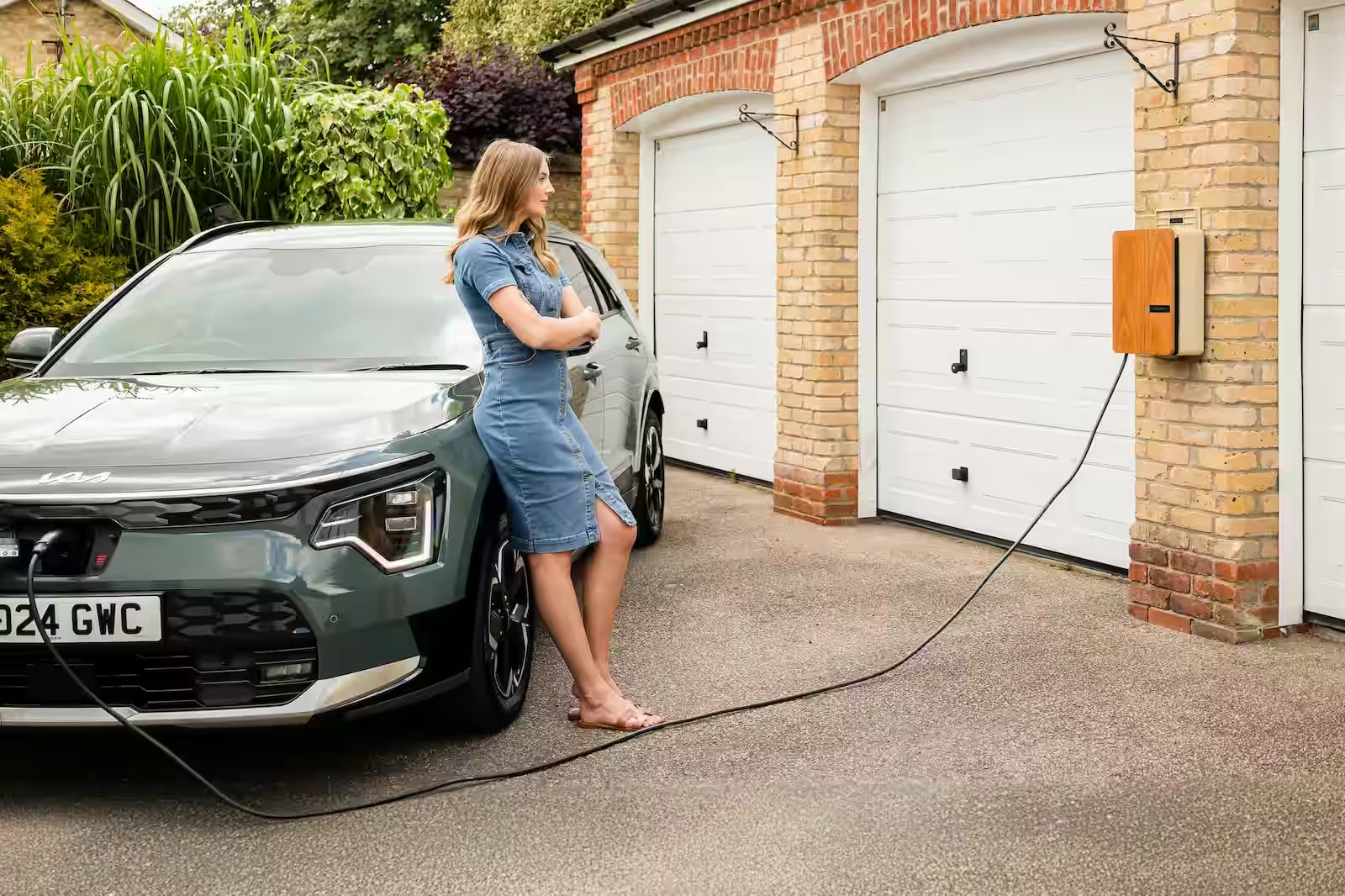
The federal EV charger tax credit that homeowners had been claiming for years — Section 30C, worth up to $1,000 — expired on 30 June 2026. If you were waiting to install a home charger, the incentive landscape has changed, and it is worth understanding what is actually still available before you budget the job.
Here is what a Level 2 charger installation involves in Rockland County and the wider Hudson Valley in late 2026: what drives the price, what your panel needs to handle it, and which programmes are genuinely still open.
Every electric vehicle comes with a Level 1 cord that plugs into an ordinary 120-volt outlet. It adds roughly three to five miles of range per hour. Over a twelve-hour overnight charge that is around 40 to 60 miles — fine for a plug-in hybrid or a very short commute, and inadequate for almost everyone else.
A Level 2 charger runs on a 240-volt circuit, the same kind your electric dryer or range uses. Depending on the charger’s amperage and what the car can accept, it adds roughly 20 to 40 miles of range per hour. A typical EV goes from nearly empty to full overnight. For anyone driving an EV as their main car, Level 2 is the only sensible answer.
The common sizes are 32-amp, 40-amp and 48-amp chargers. A 48-amp unit needs a 60-amp circuit and, under the electrical code, must be hard-wired rather than plugged in. A 40-amp charger on a 50-amp circuit is the most common residential choice and suits the vast majority of vehicles, because most cars cannot accept more than that anyway.
Charger hardware and installation are two separate numbers, and it is the installation that varies. Five factors account for nearly all of the difference between a straightforward job and an expensive one.
This is the single biggest variable. A charger mounted on the garage wall directly behind the panel is a short run of cable and an hour or two of labour. A charger at the far end of a detached garage, across a driveway, or on the opposite side of the house means a long run of heavy-gauge wire, conduit, possibly trenching, and several times the labour. Copper at 6 AWG and above is not cheap, and the cost scales directly with the distance.
A 40-amp charging circuit is a substantial continuous load. If your home is still on 100-amp service — very common in older New City, Haverstraw and Nyack houses — adding it may push you past what the service can safely carry, particularly alongside central air or electric heat. That is what a load calculation determines. If an upgrade is needed, our panel upgrade cost guide covers what that adds.
There is a middle option worth knowing about. Where capacity is marginal rather than absent, a load-management device can let a charger share the available service by throttling or pausing charging when household demand peaks. It is often significantly cheaper than a full service upgrade and works well for households that charge overnight.
Separate from capacity: a 240-volt circuit needs two adjacent full-size breaker spaces. A panel that is physically full needs a sub-panel or a rearrangement before anything new can go in, even if the service size is fine.
A garage installation is simpler. An outdoor charger needs a weather-rated unit and enclosure, proper sealing of every penetration, and appropriate mounting — a post or pedestal if there is no wall in a sensible place.
A new 240-volt circuit requires an electrical permit and an inspection in most Rockland County municipalities. Fees vary by town. This is not optional paperwork: unpermitted work commonly surfaces at resale, can void a charger’s warranty, and gives your insurer a reason to decline a claim. Our guide to electrical permits in Rockland County explains the process.
This section changes faster than any other part of the job, so treat what follows as a starting point and confirm current terms before you rely on any of it.
The federal 30C credit has expired. The credit covering 30% of charger and installation costs up to $1,000 required the equipment to be purchased and placed in service by 30 June 2026. Installations after that date do not qualify. If you had work completed before the deadline, it is still claimable on the relevant tax year — worth checking with your accountant if you installed earlier in the year.
NYSERDA’s Charge Ready NY 2.0 is a real and active programme, but it is aimed at workplace, multifamily and public charging rather than single-family homes. If you own a small commercial building, a multi-unit property or a business with a car park in Rockland or Orange County, it is worth investigating — that is commercial electrical work and a different conversation from a garage charger.
Orange & Rockland Utilities runs EV programmes including off-peak charging incentives for residential customers and its POWERREADY programme on the commercial side. Off-peak rate structures are frequently the most valuable ongoing saving available to a home charger owner, because they apply to every kilowatt-hour for as long as you own the car — often worth more over time than a one-off equipment rebate ever was. Check your account and current tariff options directly with O&R.
The practical takeaway: build your budget on the real installed cost rather than on an incentive, and treat anything you qualify for as a bonus. We tell homeowners what we know is currently live at the time we quote, and we do not quote a net price that depends on a programme we cannot guarantee.
A straightforward garage installation is typically a half-day. We confirm the load calculation, pull the permit, run the circuit from the panel to the charger location in conduit or appropriate cable, install a dedicated two-pole breaker, mount and terminate the charger, test it under load, and label the circuit clearly at the panel.
Where a panel upgrade or a long exterior run is involved, it becomes a one to two day job and the inspection is scheduled afterwards. We coordinate that rather than leaving you to chase the town.
One detail worth insisting on regardless of who does the work: the circuit should be labelled properly at the panel, and you should be shown where the breaker is. A surprising number of chargers we are called to look at were installed by someone who left neither.
All American Electrical Services has been wiring homes across Rockland County and the Hudson Valley for more than twenty years, and Phil Garabo runs every job with the same approach: assess the panel honestly, quote the whole cost including permits, and never install a charger onto a service that cannot carry it. We are licensed in Rockland, Orange, Westchester, Sullivan, Ulster and Putnam Counties.
If you are weighing up a charger alongside other electrical work, our general guide to home EV charger installation in New York covers the wider picture, and our residential electrical services page shows the rest of what we do.
A charger quote that has not looked at your panel and measured the run is a guess. We provide a free on-site estimate with an all-in figure — hardware, wire run, breaker, permit and inspection — so there are no additions on installation day.
Call (845) 786-3143 or request a free estimate. We will assess your service capacity, your parking situation and any programmes currently open to you.
No. The Section 30C credit, worth 30% of costs up to $1,000, expired on 30 June 2026 and applies only to equipment purchased and placed in service on or before that date. If your installation was completed before the deadline, speak to your accountant about claiming it for that tax year. Budget any new installation on the full cost.
A typical garage installation near the panel takes half a day. Long wire runs, outdoor mounting, trenching or a panel upgrade extend that to one or two days, with the inspection scheduled separately afterwards.
Not always. It depends on your service size and your existing connected load, which a load calculation determines. Homes on 100-amp service with central air or electric heat frequently do need either an upgrade or a load-management device; homes on modern 200-amp service usually have ample capacity.
The 240-volt circuit must be installed by a licensed electrician and requires a permit in New York. Beyond the safety issue, unpermitted work typically voids the charger manufacturer’s warranty, can invalidate a homeowner insurance claim, and is routinely flagged during a home sale.
Most Level 2 home chargers use the standard J1772 connector, which works across nearly every brand, and Teslas include an adapter. As the industry moves toward the NACS connector, choosing a charger with a detachable cable or a well-supported adapter path is the sensible hedge.
Usually not. Most vehicles cannot accept more than 40 amps on AC charging, so the extra capacity does nothing while requiring a 60-amp circuit, heavier wire and a hard-wired installation. A 40-amp charger on a 50-amp circuit is the right choice for the majority of Hudson Valley homes.
8 Phelps Street, West Haverstraw, NY 10993, USA
Mon–Sat: 7:00 AM – 3:30 PM
Sun: Closed
⭐ Rated 5.0 on Google Reviews


Book now and we'll put you at the front of the line — priority same-week scheduling across Rockland & the Hudson Valley.
Licensed. Insured. 20+ years. 5-star rated. No call-out fee for your estimate.
Call Us Now(845) 786-3143