-1.jpg)
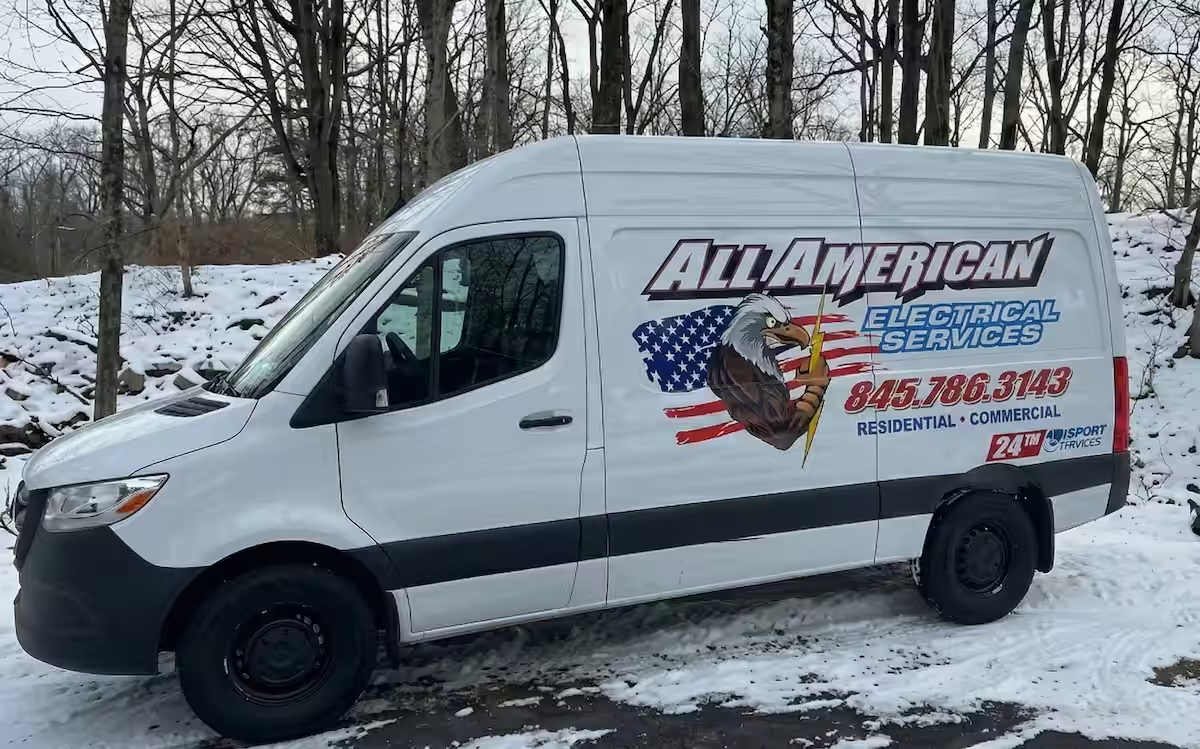
When Hurricane Ida's remnants hit the Hudson Valley in September 2021, Rockland County recorded the highest 24-hour rainfall in its history. Five years later, the storms have not gotten gentler — the March 2026 nor'easter dropped a foot of wet snow on already saturated ground and took down service lines from Haverstraw to Suffern. Every one of those failures was first an electrical event before it became a homeowner's problem.
Phil Garabo, owner of All American Electrical Service and a licensed electrician with 20+ years working across Rockland, Orange, and Westchester Counties, walks homeowners through the same pre-storm checklist he uses on his own house. None of it takes more than a Saturday afternoon, and any one of these items can save you a five-figure repair bill.
Run through this list at the start of hurricane season (June 1) and again before any named storm or major nor'easter forecast.
The single most cost-effective storm upgrade is a Type 2 whole-house surge protective device (SPD) installed at your main panel. A nearby lightning strike or a utility transient when power restores can send 6,000+ volts through your wiring in microseconds — long enough to fry every TV, computer, appliance control board, HVAC blower, and LED driver in the house. A whole-house SPD costs $350–$650 installed and typically carries a $25,000–$75,000 connected equipment warranty. Point-of-use power strips alone are not enough; they handle only the surge that gets past the panel-level device.
If you have a standby generator, run a manual exercise cycle a week before the storm and check the oil level, battery voltage, and air filter. Confirm the natural gas valve is open and the propane tank is at least half full. If you only have a portable, gas it up, test it outside, and make sure your transfer switch or interlock kit is functional — never backfeed through a dryer outlet. That is one of the most common causes of utility lineman deaths and house fires in NY.
Press the test button on every GFCI outlet (kitchen, bathrooms, garage, basement, outdoor) and every GFCI/AFCI breaker in your panel. They should trip and reset cleanly. A GFCI that does not trip is dead and offers zero protection against shock when a flooded basement meets a live outlet — a real scenario in Rockland County every storm season.
Open your main panel cover (or have an electrician do it) and look for corrosion on the bus bars, water staining at the top where the riser enters, rust around the meter base, and any breakers that feel hot to the touch with the door closed. Federal Pacific Stab-Lok and Zinsco panels — still common in homes built between 1950 and 1985 — should be replaced before storm season regardless. They are documented fire hazards under load.
Walk your property line and look at the service drop — the wire that runs from the utility pole to the weatherhead on your house. Any tree limb within 10 feet of that line is a candidate to take it down. You cannot trim near a live service line yourself; call Orange & Rockland or Central Hudson and request a clearance trim. It is a free service and they will usually respond within a few weeks.
If your sump pump is on a circuit shared with the freezer or workshop, move it to its own dedicated 20A circuit. A tripped breaker during the storm is the leading cause of basement flooding in lower Rockland County. Add a battery backup pump or a water-powered backup as a second line of defense.
A pre-storm electrical inspection from a licensed electrician typically runs $150–$300 and covers items most homeowners cannot safely check themselves. At All American Electrical Service we look at:
For a full overview of what we cover during a pre-season inspection, see our residential electrical services page.
This is the call we get most often after a Rockland County storm: a tree limb came down, the wire to the house is on the ground, and the homeowner does not know what to do. Here is the exact sequence:
This is the part that confuses every Rockland County homeowner during their first major outage. The rule is simple: the utility owns the service drop wire from the pole up to and including the weatherhead (the curved metal pipe sticking up from the roof or sidewall). Everything from the weatherhead down — the riser conduit, meter pan, panel, and all interior wiring — is yours.
What this means in practice:
The most dangerous time after a storm is the first 24 hours of power restoration. A few non-negotiable safety checks:
If water reached any outlet, switch, or the bottom of the electrical panel, do not turn power back on. Saltwater intrusion (rare here) or even clean water leaves residue that causes arcing weeks later. A licensed electrician needs to megger-test the affected circuits and replace any submerged devices. Insurance covers this in nearly every case — document with photos before cleanup.
Any outlet that got wet from rain blowing in through a broken window or a roof leak is suspect. Trip the breaker, dry it for 48 hours, and have it tested before re-energizing. Replace any outlet with visible corrosion.
If you smell burning plastic or notice scorch marks near any outlet, switch, or the panel itself, kill the main breaker and call immediately. This is an active arc fault and a house fire is hours away, not days. Do not wait for business hours. Our team at All American Electrical Service handles emergency calls across Rockland County 24/7.
If you ran a portable generator during the outage, verify the transfer switch or interlock is fully reset to utility power before the line crew re-energizes. A backfed generator can kill linemen and is a felony under NY law.
If you are reading this list and realizing your home is not ready, the highest-value upgrades for the 2026 storm season, in priority order, are:
If you are in Westchester or planning to coordinate work across county lines, you can reach our Westchester County electrician team for the same pre-storm package.
Storm season does not wait for a convenient weekend. The right time to harden your electrical system is now, before the first named storm of the year hits. Request a free pre-storm electrical evaluation from All American Electrical Service and we will walk your home with you.
Stay clear of any downed lines and assume they are live. Call your utility first (Orange & Rockland at 1-877-434-4100 or Central Hudson at 1-845-452-2700) — they own the service drop up to the weatherhead. Once the utility has secured the line, call a licensed electrician to inspect and repair the meter pan, riser, panel, and any interior wiring before power is restored.
A Type 2 whole-house SPD will handle every surge a typical NY home sees — utility switching transients, nearby lightning strikes, and grid recovery surges. A direct strike to your home is a different scenario that no surge protector is rated for, but those are extremely rare. The SPD's real job is the 90% of damaging events that come through the utility lines, and there it is highly effective.
Not safely or legally without a properly installed transfer switch or interlock kit. A 7,500-watt portable can run essentials (fridge, furnace, well pump, a few lights) through an interlock, but it cannot power 240V loads like central AC or an electric range at the same time. Never backfeed through a dryer outlet — it kills utility workers and is a felony in New York.
A full pre-storm inspection every 3–5 years is enough for most Hudson Valley homes, with a quick visual check by the homeowner each June. Homes over 40 years old, homes with knob-and-tube or aluminum branch wiring, and homes with Federal Pacific or Zinsco panels should be inspected annually until those systems are upgraded.
8 Phelps Street, West Haverstraw, NY 10993, USA
Mon–Sat: 7:00 AM – 3:30 PM
Sun: Closed
⭐ Rated 5.0 on Google Reviews


Book now and we'll put you at the front of the line — priority same-week scheduling across Rockland & the Hudson Valley.
Licensed. Insured. 20+ years. 5-star rated. No call-out fee for your estimate.
Call Us Now(845) 786-3143